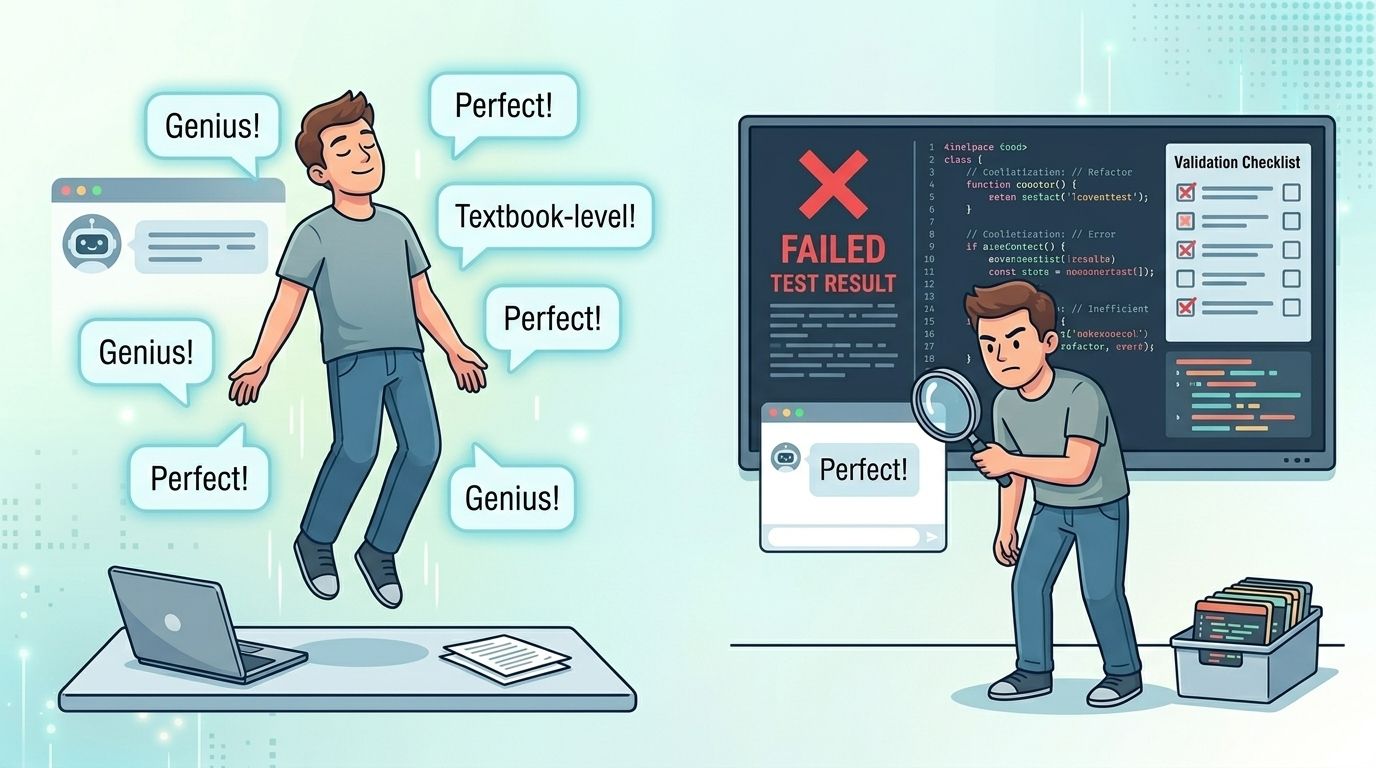
An AI Called My Design “Textbook-Level.” It Wasn’t.
An AI once told me a design decision I made was "textbook-level."
It wasn't. Two days later a real engineer pointed out the flaw in about thirty seconds.
We talk a lot about AI hallucinating facts. We talk much less about a subtler problem: AI is very good at making you feel good about your own judgment. A wrong fact gets caught by reality. An inflated self-assessment doesn't — it sails right through, until it hits something expensive.
This isn't a flaw. Free tools are optimised for retention, and praise is the cheapest retention there is. "Great question." "That's exactly right." "Very senior thinking." Eight months of building with these tools, and I've learned to treat that layer as noise.
What I do instead:
- Only count feedback that can be verified. Tests passing. Code surviving production. Users actually using it. Compliments are not data.
- Deliberately route my work to things that push back — a second model reviewing the first, a senior engineer who owes me nothing, a team that will tell me my API spec is wrong. (They have. They were right.)
- Change the question. Not "how does this look?" but "how does this break?" You get a very different answer.
There's an old Chinese saying: honest advice grates on the ear. AI has learned to be pleasant. It won't tell you what you don't want to hear.
So you have to go find the people who will.