TITAN
Built for an Australian leading industrial services company — a Level-4 automated scheduling and decision engine transforming manual workforce coordination into intelligent, self-optimizing operations.
problem
An Australian leading industrial services company operated a growing portfolio of field projects across a wide geographic area. Scheduling was managed through Google Sheets — a manual, error-prone process that could not scale. Coordinators spent hours each day assigning operators to jobs, often producing suboptimal routes that wasted fuel and time. The company needed an automated system that could handle complex constraints: operator skills, job priorities, travel distances, time windows, and real-time changes.
solution
TITAN was designed as a Level-4 automated scheduling and decision engine — capable of generating, evaluating, and executing scheduling decisions with minimal human oversight. The system ingests job requests, operator availability, and geographic data, then produces optimized daily schedules through a combination of greedy initialization and multi-stage iterative refinement using Vehicle Routing Problem (VRP) algorithms.
architecture
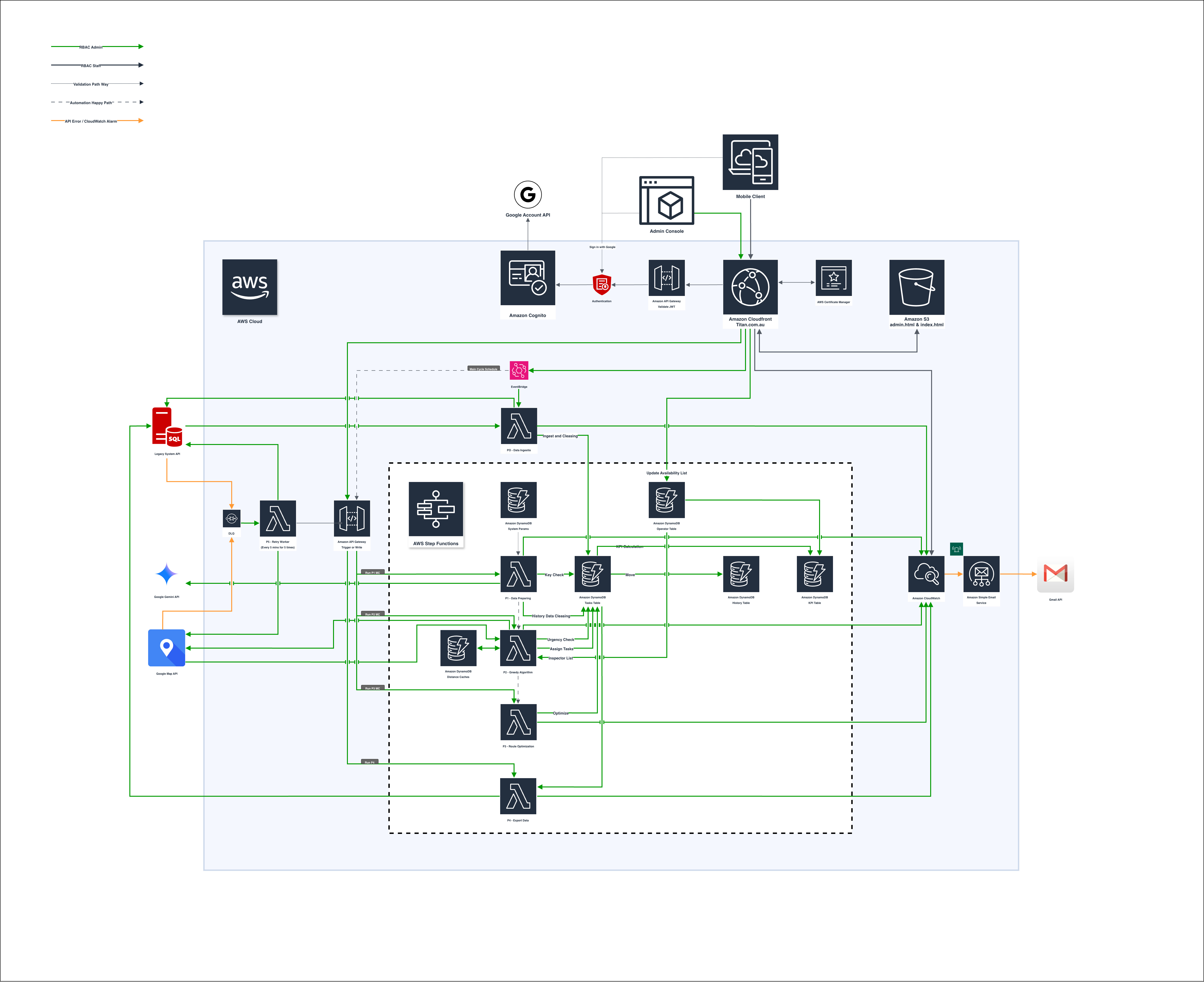
The platform is built on a fully serverless architecture, leveraging managed cloud services for compute, storage, and integration. Key architectural decisions include a read/write split for performance isolation, role-based access control (RBAC) for multi-tenant security, and event-driven processing for real-time schedule updates.
technical attributes
- >Serverless Architecture — Fully managed infrastructure with auto-scaling compute, eliminating operational overhead and enabling cost-efficient processing of variable scheduling workloads.
- >Gemini & Google Maps API Integrations — Gemini powers natural-language job parsing and intelligent constraint extraction; Google Maps provides real-time distance matrices and geocoding for accurate travel-time estimation.
- >Greedy + Multi-Stage Iterative VRP Algorithms — A greedy heuristic generates an initial feasible schedule, then multi-stage iterative refinement (swap, relocate, 2-opt) progressively improves route quality against time-window and capacity constraints.
- >Role-Based Access Control (RBAC) — Multi-tenant security model with granular permissions for coordinators, operators, and administrators, enforced at both API and data layers.
- >Read/Write Split — Separated read and write paths for performance isolation; read-heavy dashboard queries served from optimized projections while write operations maintain strong consistency.
- >RAG AI Helper — A Retrieval-Augmented Generation assistant that surfaces relevant scheduling policies, historical patterns, and operational documentation to support coordinator decision-making.
- >Google Sheets → Firestore Migration — A structured data migration from the legacy Google Sheets scheduling system to Firestore, preserving historical records while enabling real-time synchronization and query capabilities.
results
The TITAN engine replaced a fully manual scheduling workflow with an automated system capable of producing optimized daily schedules in seconds. Coordinators shifted from route-planning to exception-handling, and the company gained the ability to scale operations without proportional increases in coordination overhead. The migration from Google Sheets to Firestore eliminated data integrity issues and enabled real-time visibility across the organization.
TITAN Operational Outcomes
Daily Scheduling Duration
Hybrid greedy & VRP algorithm execution frees coordinators from manual calculations.
Field Info Lookup Time
Core shift databases and order contexts are seamlessly linked, eliminating search silos.
Inter-department Friction
Completely eliminates email-tag games, aligning coordination pipelines instantly.
System & Data Security
Phases out easily-damaged shared sheets, enforcing robust RBAC to prevent accidental loss.