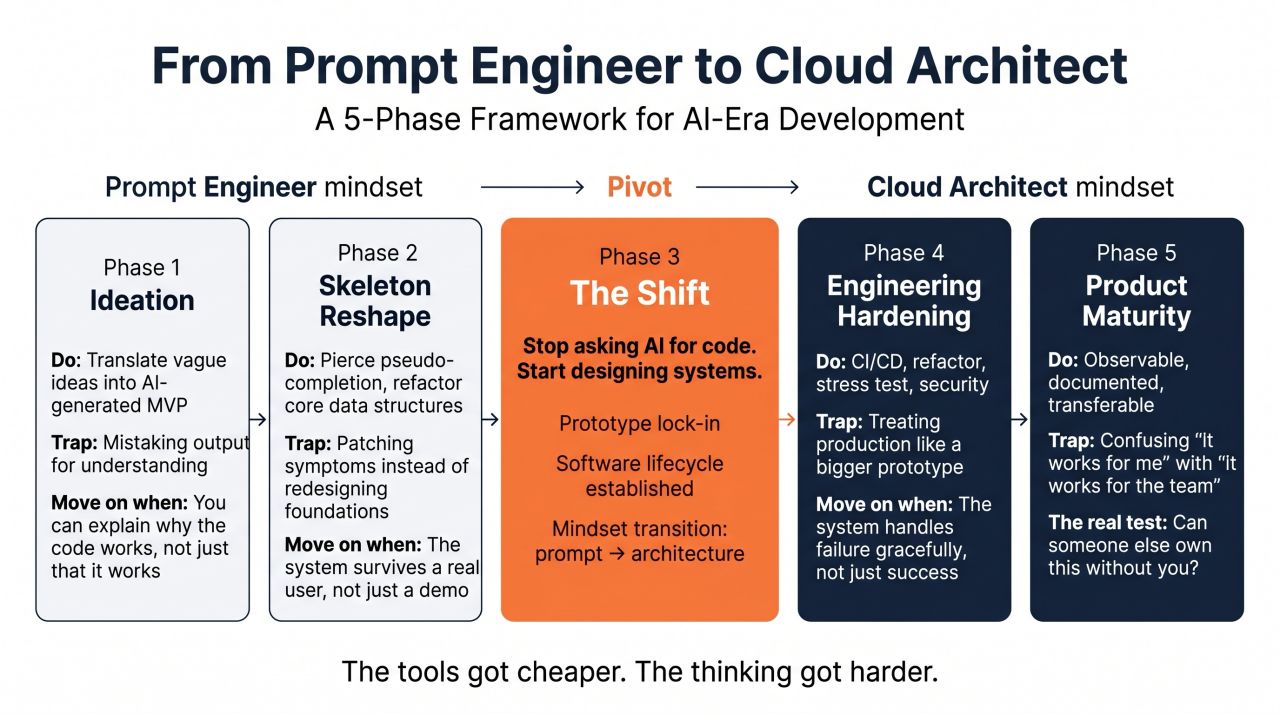
The Tools Got Cheaper. The Thinking Got Harder.
When I first started coding with AI, I felt invincible.
Within weeks, I built a full stack internal system that would normally take a team months to do. I thought the barrier is gone. I can build anything now.
Then came the valley of despair.
Pseudo-completion. Spaghetti code. Concurrency issues and poor database design I didn’t even know existed. Production failures at 12AM. The realization that “it runs on my machine” and “it’s a real product” are continents apart.
I’m climbing out now — somewhere on the slope of enlightenment. Along the way, I’ve shipped a production systems and a personal app on the App Store. Not because the tools made it easy, but because the failures taught me what the tools couldn’t.
But the climb is lonely.
AI-assisted development is still a new identity. Traditional engineers question whether it counts as “real” engineering. People outside tech see it as either magic or a shortcut. The conversations I want to have — about architecture trade-offs, about when to trust the model and when not to — are hard to find.
So I write. I document. I share frameworks like this one.
Not as a manifesto. Not as advice. Just a map of where I’ve been, in case someone walking a similar path finds it useful.
The tools got cheaper. The thinking got harder.
If you’re on the same path, I’d love to hear where you are.