AI Shortens the Path to a Prototype, but Lengthens the Path to Production
Had a coffee chat with my friend that turned into a debate about how AI automation should actually be built.
His view was simple: if a business already has an SOP, AI should replace the human directly.
My view was different: first digitize and standardize the process, build the workflow skeleton, and then decide where AI should be used at each node, with humans available as a fallback.
In practice, I think the best approach is a combination of both.
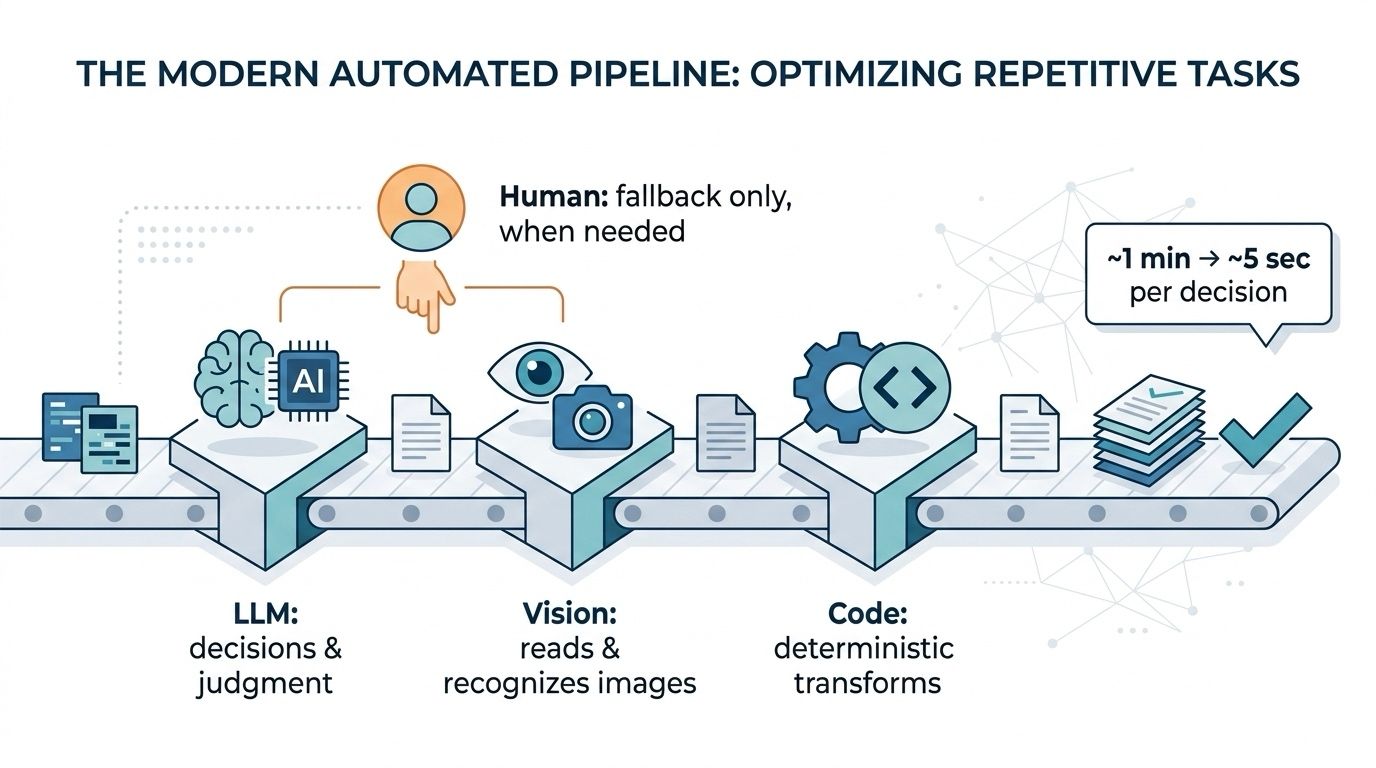
The first step is to understand the type of problem being solved, because not every step needs AI. Different tasks require different tools:
- an LLM for judgment-based decisions;
- a vision model for image-related tasks;
- traditional code for deterministic transformations.
Humans do not necessarily need to operate every step. They can monitor the process and step in when edge cases appear.
For a prototype, this approach can work extremely well. A decision that previously took around 1 minute can be reduced to approximately 5 seconds.
But a prototype is not a production system, and closing that gap is where most of the real work begins.
For example, if each node in a five-step workflow is 90% accurate, the theoretical end-to-end accuracy may fall to:
0.9⁵ ≈ 59%
Of course, real systems are more complicated than this calculation suggests, but the principle remains: errors can accumulate across a workflow.
“Works in a demo” and “safe to deploy” are two very different standards.
One way to manage this is through graceful degradation. For example, when the AI is uncertain about a judgment, the system can mark the result as “AI Uncertain” without stopping the rest of the workflow. A human can then review the flagged decisions at the end of the process.
A well-designed SOP may cover some common scenarios and improve overall accuracy. However, real-world workflows will always contain incomplete, inconsistent, or incorrect data entered by humans, which makes production systems less predictable.
This is the pattern I keep seeing:
AI shortens the path to a prototype, but lengthens the path to production.
That is also why this type of work often suits a Forward Deployed Engineer: someone who understands both the business process and the engineering required to automate it.
You cannot decide where automation belongs, which steps require judgment, or where humans need to remain involved unless you understand how the actual workflow operates.
Technical people who understand the business are still underrated.