What AI Didn’t Build for Me
AI compressed my build time by 10x and more. It did nothing for the four things that actually decide whether a prototype becomes a product.
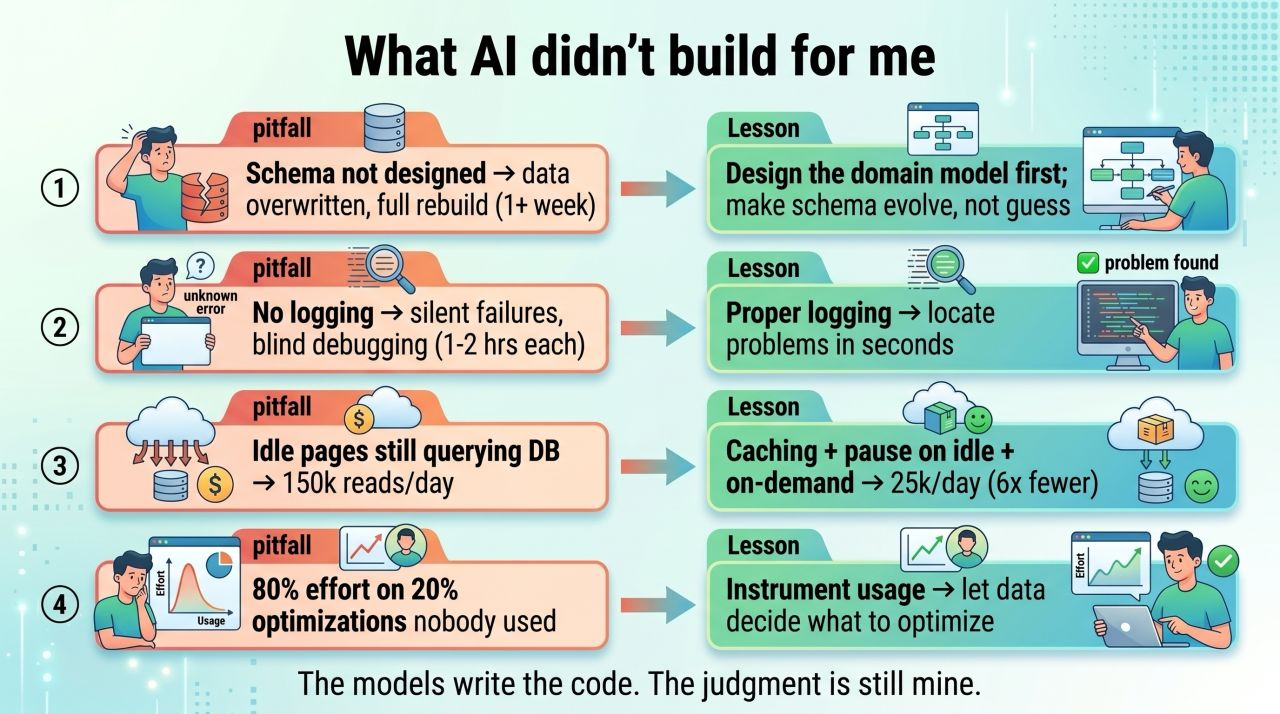
1. Data modeling.
I didn’t define my schema carefully — fields started overwriting and losing data, and I ended up rebuilding the entire database. That rebuild cost me over a week. My first instinct was “next time I’ll leave spare fields just in case” — then I realized that’s just over-engineering.
The real lesson: think the domain model through before the first line of code, and design the schema to evolve, not to guess every future need. (The rebuild also cut writes by ~2/3, almost as a side effect of doing it right.)
2. Observability.
No real logging, so the system failed silently and I debugged blind.
Setting up proper logging (wiring in CloudWatch) took real time — but the payoff was huge: debugging that used to take 1–2 hours of going back and forth with AI now takes seconds.
3. Cost.
I assumed serverless + a free tier meant I was safe. Then I found the counterintuitive part: a page sitting open with nobody touching it was still subscribing to the database. Idle isn’t free.
I was running ~150k reads/day. Caching, pausing subscriptions on idle, and reading on demand brought it to ~25k — 6x fewer, users felt nothing.
4. Product judgment.
I poured time into algorithms and slick UX — 80% of my effort on 20% optimizations nobody used. So I started instrumenting everything: how often each function runs, how often each screen is opened.
Now usage data tells me what’s actually worth optimizing, instead of my guesses.
The thread through all four: data design, observability, cost, product judgment.
AI took over the implementation. It touched none of these. And these four are the entire distance between “a prototype that runs” and “a product people use.”
The models write the code. The judgment is still mine.