My Digital Scrum Team: Four AI Models and a Human PO
I built a “Digital Scrum Team” on my own project: four AI models working in defined roles, backed by objective testing and a human PO fallback — a pipeline that keeps running while I sleep.
Here’s the setup:
Antigravity (Gemini Models) for fast MVP validation
Kiro’s Spec-Driven mode for the PRD + design docs and task generation — those tasks become my product backlog
Sprint planning with Claude Code — the week’s code is done on day one
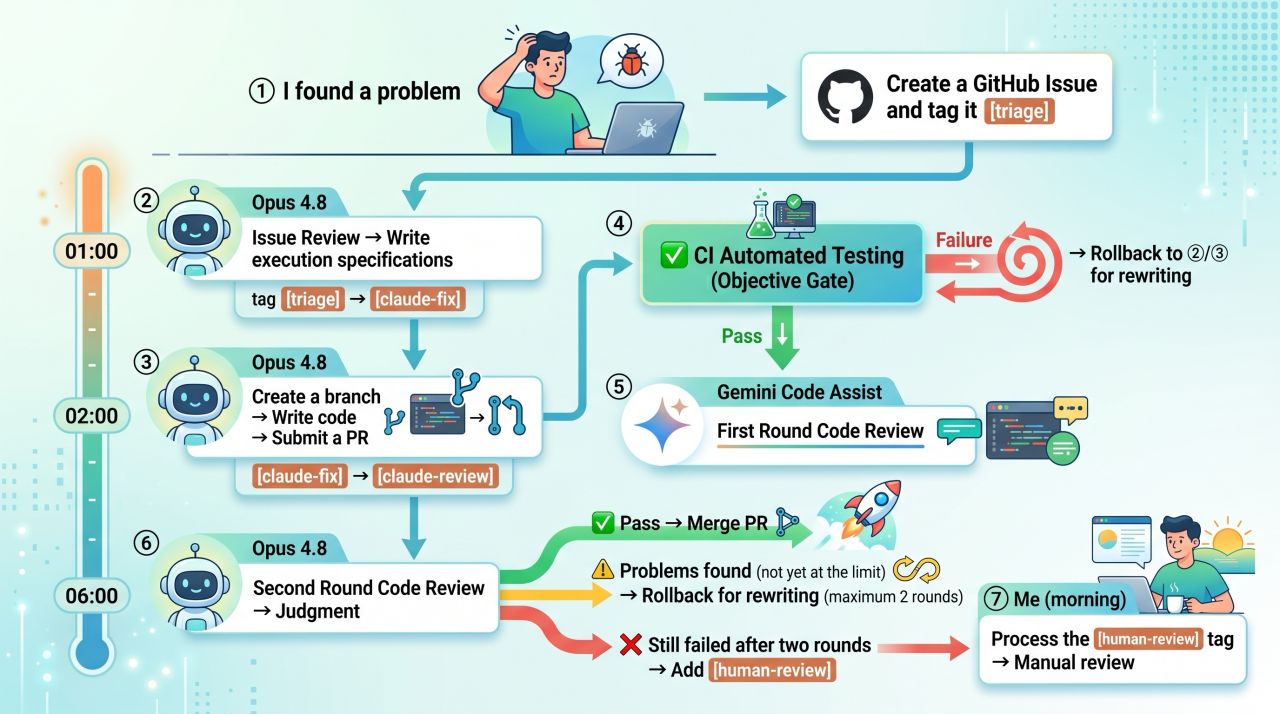
The interesting part is the testing phase. I log bugs, logic issues, and UI problems as GitHub issues and tag them [triage]. Then an automated pipeline (Claude Code’s Routine feature) takes over:
1 AM — Opus 4.8 reviews the issue and writes an execution spec. [triage] → [claude-fix]
2 AM — Opus 4.8 branches, writes the code, opens a PR. [claude-fix] → [claude-review]
CI runs automated tests as the objective gate — fail, and it goes straight back for a rewrite
Pass → Gemini Code Assist runs the first review
6 AM — Opus 4.8 runs the second review
Max two loops. If it’s still not resolved, it’s escalated to me: [human-review].
I wake up and only handle the few issues tagged [human-review]. At the end of each sprint, a Model pass reviews every issue and PR from the week and writes a retrospective log.
One four-model pipeline. Dual-model review. Objective tests as the gate. Human in the loop.
To be clear: this runs on a foundation. Claude Code isn’t something you master on day one — if I’d tried this when I started a few months ago, I couldn’t have driven it.
This is an experiment on a personal project. Still iterating.
The models write the code. Deciding what ‘done’ means is still my job.