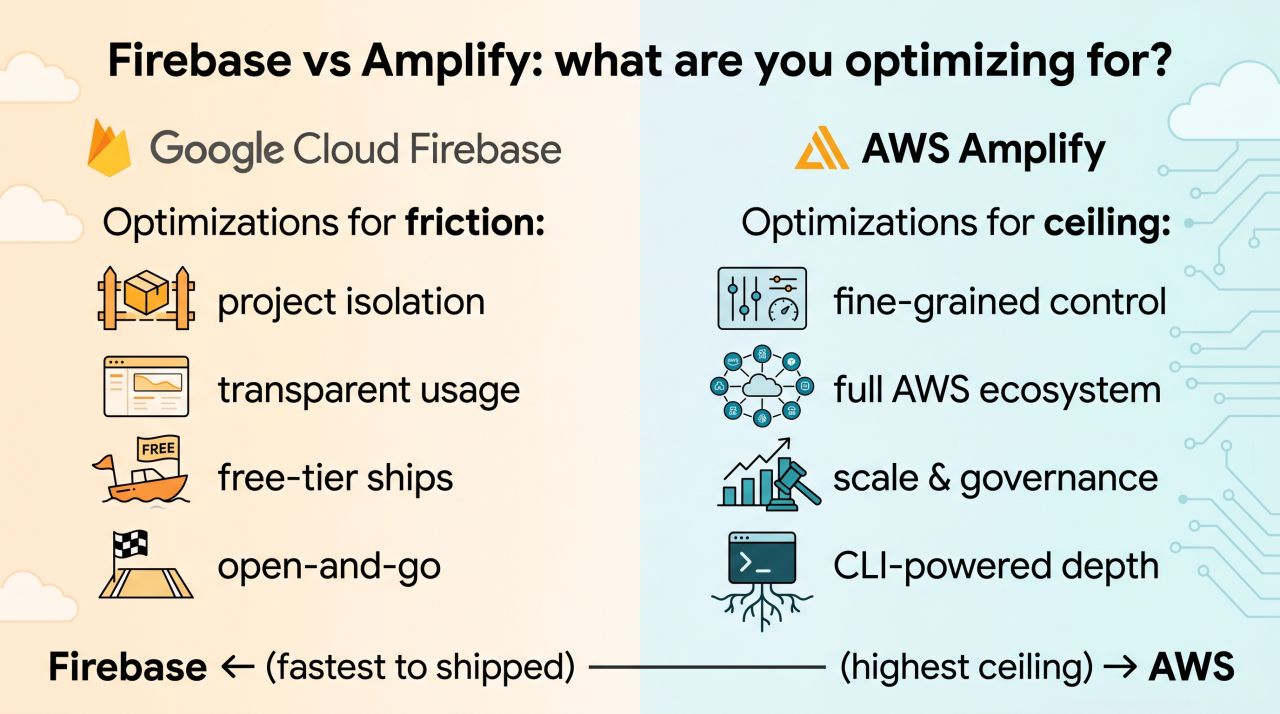
Firebase vs Amplify: What I Actually Tripped Over
I've spent the last few months building real things on both Firebase and Amplify. This isn't a textbook comparison — it's the stuff I actually tripped over, and what it taught me.
The first thing that bit me: everything piled into one account.
On AWS I didn't separate things by project early on, so every service from every project ended up stacked in a single account. It got messy fast, and I eventually had to set up AWS Organizations just to untangle it. Firebase had quietly saved me from this the whole time — every project is its own isolated unit by default, with its own IAM and its own billing account. Lesson: with Firebase, isolation is the default; with AWS, isolation is something you have to design for up front.
The second thing: "let me just check my data."
With Firebase, I'd open the console and immediately see where my reads, writes, and cost were going — usage and quota are right there. With Amplify, when I wanted to inspect what was in DynamoDB, I had to open that service's own console separately, or drop into the CLI — which means having your local environment set up before you can even look. The first time, that friction genuinely surprised me. Lesson: Firebase optimises for "open and see"; AWS assumes you're comfortable living in the CLI and across separate service consoles.
The third thing: the free tier actually ships.
For small-to-mid projects, Firebase's free tier let me build genuinely useful functionality without thinking about cost. That lowers the barrier to just start.
So is Firebase simply easier and Amplify simply harder? Not quite — and this is the part that took me a while to see.
Amplify's friction is AWS handing you the full toolbox. The same depth that makes it harder to open and inspect is what gives you control and reach Firebase doesn't. What feels like overhead on a weekend project is exactly what you need when something has to scale, integrate deeply, or be governed at an enterprise level.
It's also worth being precise about what these even are: Firebase is a self-contained backend platform; Amplify is more of a layer that orchestrates AWS's underlying services. That's why one feels seamless and the other feels more hardcore — it's baked into how they're built.
So the real lesson, for me, wasn't "Firebase good, Amplify hard." It was this:
Firebase optimises for friction — fastest to shipped. AWS optimises for ceiling — furthest once you're there.
Small, fast, low-ops, easy to monitor → Firebase is tough to beat. Scale, deep integration, enterprise control → AWS's complexity is the value.
The mistake is picking the tool you like. The skill is picking the one that fits the project's stage and constraints.
Pick for the constraint, not the comfort.